Why this self-healing composite matters in 2026
Self-healing composites are suddenly getting a lot of attention, and for good reason. Researchers at NC State say this new composite could last for centuries because it can heal delamination damage more than 1,000 times in lab testing. If that holds up in real use, your future cars, airplanes, wind turbines, and even spacecraft parts may need far fewer replacements.
That is a big deal because today’s fiber-reinforced polymer, or FRP, parts are strong and light, but they do not age gracefully when hidden cracks spread between layers. Once that damage grows, mechanics often have to inspect, repair, or replace the part. This new approach tries to stop that cycle by making the composite itself part of the repair system.

The problem: why composite parts fail long before the fibers do
FRP composites are used in car bodies, airplane wings, wind turbine blades, and space hardware because they offer high strength without a huge weight penalty. But one failure mode has haunted them since the 1930s: interlaminar delamination.
In plain English, delamination happens when cracks grow between layers of fiber reinforcement and the polymer matrix. Think of it like a strong stack of thin sheets that begins to separate internally. The outside may still look fine, but the structure loses toughness and can fail much sooner than expected.
That weakness is one reason many conventional FRP components are designed around service lives of about 15 to 40 years. The fibers may still be valuable, but the layered structure becomes vulnerable after repeated stress, impacts, weather exposure, or maintenance events.
For aircraft composite materials, this is especially important. Aerospace engineers love composites for their strength-to-weight ratio, but they also have to deal with damage from impacts, erosion at leading edges, fatigue, and hard-to-see internal cracks. In cars, even smaller damage from road debris or repeated vibration can build up over time.
How the new self-healing composite works
The NC State team kept the basic idea of a laminated FRP composite, then added two smart features.
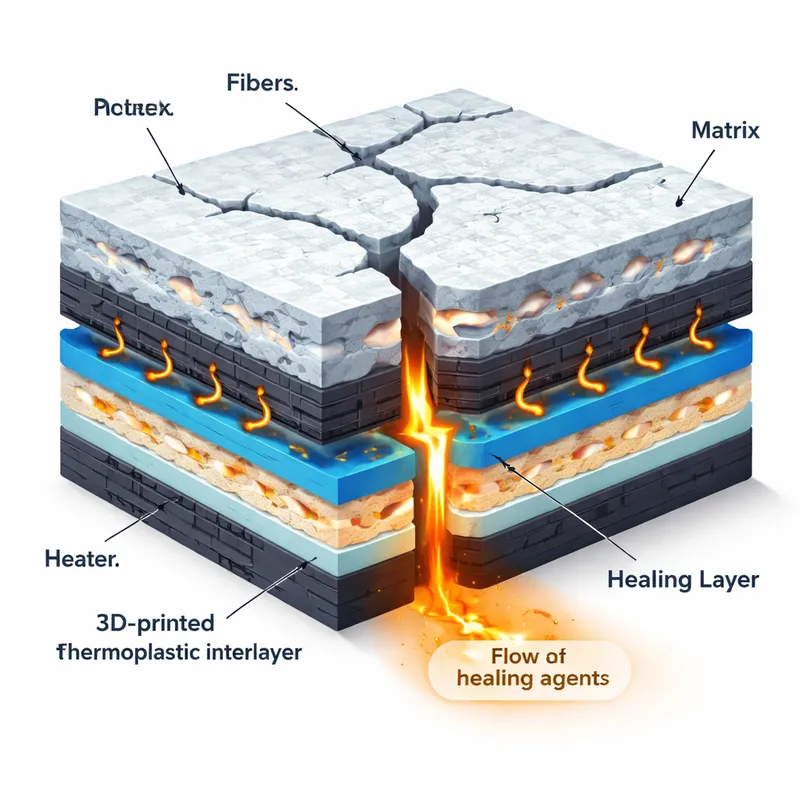
First, they 3D-printed a thermoplastic healing agent onto the fiber reinforcement. This created a patterned interlayer inside the laminate. Reports on the study describe the healing polymer as poly(ethylene-co-methacrylic acid), or EMAA.
Second, they embedded thin carbon-based heater layers in the composite. When electrical current runs through those heaters, they warm up and melt the thermoplastic healing agent.
Once melted, the healing agent flows into cracks and microfractures, then cools and re-bonds the damaged interface. So instead of sending a part away for a major structural repair, the material uses healing chemistry already built inside it.
That is the core trick. The composite can heal itself more than 1,000 times because the healing agent is not sprayed on from the outside after damage. It is already there, waiting to be activated.
Why this design starts stronger than regular composites
What I find especially interesting is that the new material is not only about repairing damage after the fact. The 3D-printed interlayer also improves the laminate before any healing is triggered.
According to the research summaries, the polymer-patterned interlayer makes the laminate 2 to 4 times more resistant to delamination from the start. That means the material is both harder to crack and able to repair itself after cracks form.
That combination matters. A lot of futuristic materials sound great because they can recover after damage, but if they begin weaker than the standard version, engineers may hesitate to use them. Here, the self-healing version begins tougher than an unmodified laminated composite.
Lead author Jack Turicek said the material starts out significantly tougher, and its interlaminar toughness declines only slowly with repeated healing. That slow decline is what makes the century-scale life estimates possible.
What the tests actually showed
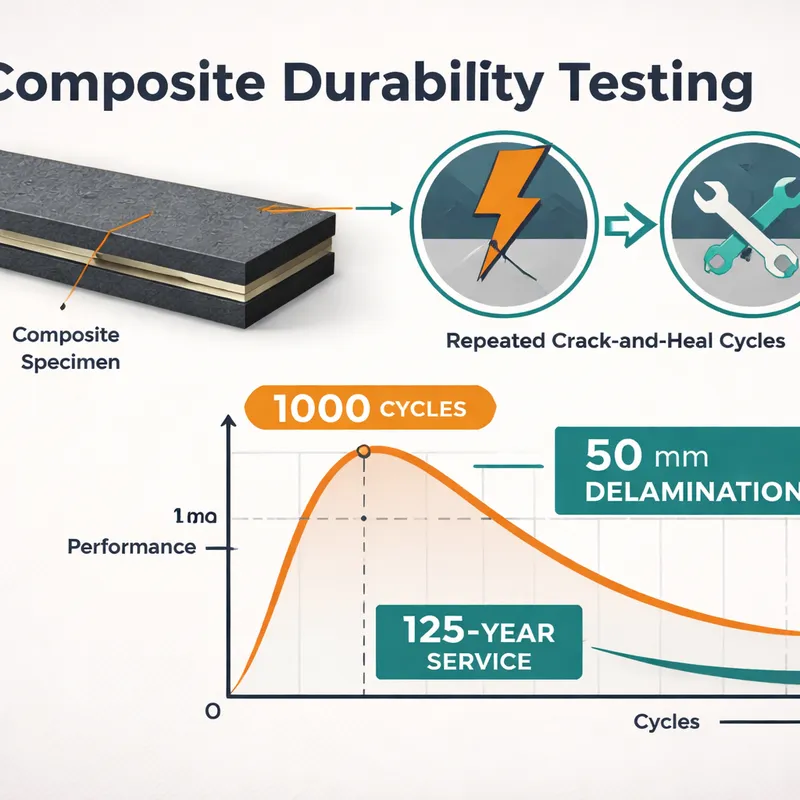
This was not a one-off demo where a tiny scratch closed once under perfect lab conditions. The researchers built an automated testing system that repeatedly cracked and healed the samples in a controlled way.
Each cycle created roughly a 50 mm delamination in the FRP composite. Then the thermal remending process was activated to heal the damage. After healing, the team measured how much load the specimen could withstand before delaminating again.
They repeated that process 1,000 times over 40 days.
Here are the headline results:
- The composite healed fracture damage more than 1,000 times in laboratory testing
- It started with fracture resistance above that of unmodified composites
- It resisted cracking better than currently available laminated composites for at least 500 cycles
- Interlaminar toughness declined over time, but slowly
- Modeling suggested healing performance begins at about 175% of a baseline metric and gradually declines toward 60% of the mode-I fracture resistance of a plain composite
- A Weibull-based model predicted an asymptotic healing limit above 40%, which supports the idea of sustained long-term repair
That last point is important. Engineers do not need infinite recovery to make a material useful. They need enough repeatable recovery to keep structural performance above a safe threshold for a very long time.
Could cars and airplanes really last for centuries?
Maybe not every whole vehicle, but some major composite parts could. That is the more realistic way to read the research.
The team estimates the self-healing material could last:
- 125 years with quarterly healing
- 500 years with annual healing
These estimates are for the composite material under modeled maintenance schedules, not a promise that an entire plane will fly for 500 years. Systems, engines, electronics, interiors, regulations, and design standards change long before that. Still, if a structural composite panel or wing section can survive far longer than current materials, that could reshape maintenance planning.
For cars, this might mean body structures or lightweight panels that outlast the rest of the vehicle. For airplanes, it could reduce the number of costly composite replacements. For wind turbines, it could keep blades in service longer and cut waste. For spacecraft, it could matter even more because repair access is limited or impossible.
When the healing would happen in the real world
The composite is not expected to stay warm and heal nonstop. Instead, healing would likely be triggered after specific damage events or during planned maintenance.
Examples include:
- Hail damage
- Bird strikes
- Impact events during operation
- Scheduled service checks
- Maintenance windows in aerospace or wind energy systems
That makes practical sense. You do not need continuous healing if you can detect damage and run a controlled heating cycle when needed. Some reports note that autonomous damage detection is still a step ahead, but likely on the near horizon.
A future aircraft could, for example, detect impact damage in a panel, apply current to the heater layer, melt the healing agent, and restore part of the lost toughness before the crack spreads further.
Why healing gets weaker over time
No material repairs forever at full strength. The interesting thing here is that the decline appears gradual rather than sudden.
The research points to two main reasons for the drop in healing efficiency:
- Brittle fibers gradually fracture and create micro-debris. That debris reduces the number of clean surfaces where rebonding can happen.
- Chemical reactions between the healing agent and the surrounding fibers or matrix decline over time.
So yes, the healing becomes less effective after many cycles. But the team argues that it remains effective enough for very long service life, especially under periodic maintenance schedules.
That balance between realistic degradation and useful long-term performance is what makes this work feel more serious than a flashy lab trick.
Why this could matter for cost, waste, and energy use
Longer-lasting composite parts could save money, but the bigger story may be waste reduction.
Today, many lightweight composite structures are hard to repair and hard to recycle. So damaged components often get replaced rather than restored. That means more manufacturing, more material use, more transport, and more scrap.
If self-healing composites reduce the number of parts that must be removed from service, you could see benefits such as:
- Lower maintenance labor
- Fewer replacements
- Less industrial waste
- Lower energy use tied to remanufacturing
- Longer service life for expensive structures
Wind energy is a good example. Wind turbine blades already pose a disposal problem, and the National Renewable Energy Laboratory has projected millions of tons of blade waste by 2050 under current trends. Extending blade life would not solve recycling by itself, but it could reduce how quickly that waste pile grows.
What still needs to happen before mass adoption
As promising as this sounds, there is still a gap between strong lab evidence and widespread use in production vehicles or aircraft.
Engineers still need answers to questions like:
- How does the composite behave under real temperature swings, humidity, and long-term fatigue?
- How well does it perform after messy impact damage instead of idealized lab cracking?
- How reliable are the heater layers over many years of service?
- What sensing system will detect damage and trigger healing at the right time?
- How easy is it to certify for aerospace use?
The good news is that the technology was designed to integrate with existing composite manufacturing processes. It has also been patented and licensed through Structeryx Inc., and the researchers say they are working with industry and government partners.
That does not guarantee fast adoption, but it does suggest this is moving beyond a paper-only concept.
Who developed it and where it was published
The work was led by researchers at North Carolina State University, with collaboration from the University of Houston.
Key names connected to the study include:
- Jason Patrick, corresponding author at NC State
- Jack Turicek, lead author and graduate student at NC State
- Kalyana Nakshatrala, co-author from the University of Houston
The paper is titled Self-healing for the Long Haul: In situ Automation Delivers Century-scale Fracture Recovery in Structural Composites and was published in Proceedings of the National Academy of Sciences on January 9, 2026. The DOI is 10.1073/pnas.2523447123.
Support came from SERDP and the National Science Foundation.

What this means for the future of vehicles and aerospace
If you step back, the idea is simple. Instead of treating internal cracks as the beginning of the end, this composite treats them as a maintenance event.
That could change how you think about durability. Cars might keep lightweight composite panels far longer. Airplanes could reduce some structural replacement cycles. Spacecraft could gain extra resilience in places where repairs are difficult. Wind turbines might stay useful longer before blade replacement becomes unavoidable.
The biggest takeaway is not that every product will literally survive for 500 years. It is that structural composites may no longer have to be disposable on a decades-long clock.
And honestly, that is exciting enough.
FAQ: Self-healing materials, spacecraft, aerospace, and aircraft composites
What material can heal itself?
Several kinds of materials can heal themselves. The most common self-healing materials are polymers and elastomers, but the category also includes metals, ceramics, and cementitious materials. In this NC State research, the self-healing system is a fiber-reinforced polymer composite that uses a thermoplastic healing agent and embedded heaters to repair delamination damage.
How will self-healing spacecraft work?
Self-healing spacecraft are expected to use built-in repair systems that activate after impacts or stress. One practical approach is to heat the material so an internal healing agent softens, reflows into damage, and re-bonds the structure. That matters in space because repairs are expensive, time consuming, and often impossible once a spacecraft is deployed.
What are self-healing composites in aerospace?
In aerospace, self-healing composites are composite materials designed to repair damage that occurs during service, such as impact damage or internal cracking between layers. Their main advantage is that they can restore some structural performance, maintain impact resistance, and extend the service life of aircraft components.
What are the disadvantages of aircraft composite materials?
Aircraft composite materials offer major strength-to-weight benefits, but they also come with tradeoffs. One known disadvantage is susceptibility to erosion, especially at edges and leading surfaces. They can also suffer from hidden internal damage such as delamination, which is difficult to detect and can lead to costly inspection, repair, or replacement.
Can this composite really heal itself more than 1,000 times?
In lab testing, yes. The research team reported more than 1,000 fracture-and-heal cycles using an automated system. The samples were repeatedly delaminated and then thermally healed using the embedded healing system.
What damage does this self-healing composite repair?
It is designed to repair interlaminar delamination, which is damage that separates layers inside a laminated composite. The melted healing agent flows into cracks and microfractures, then solidifies to re-bond the interface.
Could this technology be used in cars and airplanes soon?
Possibly, but not overnight. The material was designed to fit with existing composite manufacturing methods, and the technology has already been patented and licensed. Still, real-world validation, sensing systems, certification, and scale-up work are still needed before broad use in commercial vehicles or aerospace fleets.

