PlayStation 6 leak: what the 12x ray tracing claim actually says
The PlayStation 6 leak making the rounds in 2026 is easy to summarize: PlayStation 6 may triple rasterized performance and boost ray tracing by 6 to 12, and PS6 might deliver up to 10 times better ray tracing performance depending on which leak summary you read. One report even frames it as PlayStation 6 Leak Tips 4K 120 FPS "In Most" games. That sounds huge. It also sounds like the kind of claim you should not accept at face value.
Right now, the key point is simple. These are still rumors, mostly tied to claims from Moore's Law Is Dead and discussion around alleged AMD roadmap details. Sony has not confirmed specs, pricing, clock speeds, memory setup, or launch timing.
If the leaks are even close, the headline is not just raw power. It is the mix of better raster performance, much stronger RT hardware, and likely heavier use of AI upscaling and PSSR-style image reconstruction.
What the leak claims: 3x raster, 6x to 12x ray tracing
Across the reports, the numbers stay fairly consistent:
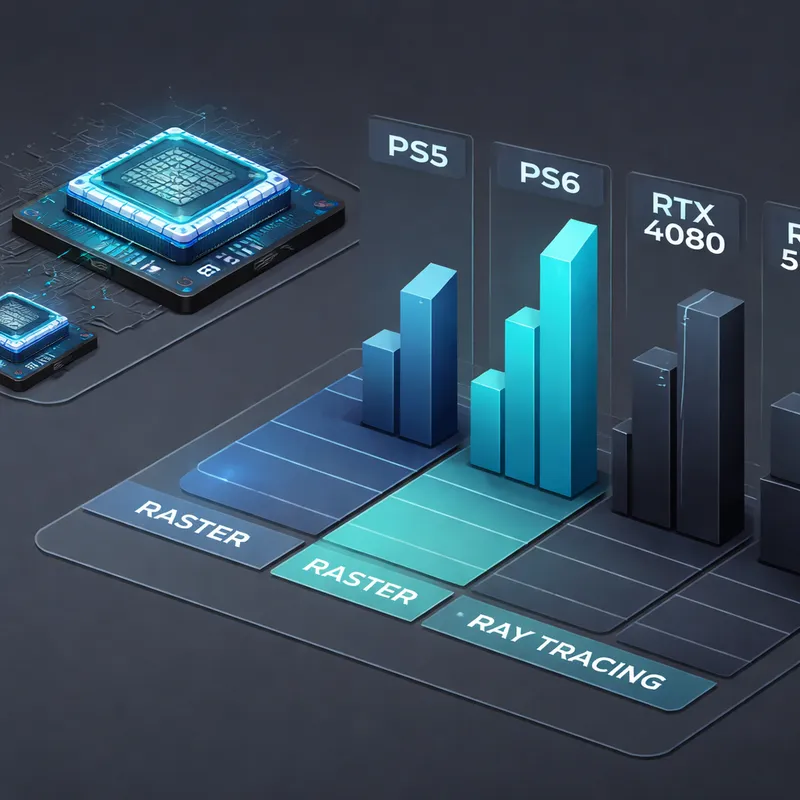
- Around 2.5x to 3x rasterized performance over the base PlayStation 5
- Around 6x to 12x ray tracing performance over the base PS5
- In some retellings, up to 10x better ray tracing is used as the cleaner headline
- Some speculation points to 4K 120 FPS in many games, though that depends heavily on the game, settings, and use of upscaling
That sounds like a monster leap, but you should separate raster performance from ray tracing performance.
Raster is the more traditional graphics workload. It is what most players think of as the baseline GPU power used to draw the game world. Ray tracing is a more advanced lighting method that handles reflections, shadows, and global illumination in a more realistic way.
So when you read 12x faster ray tracing, that does not automatically mean 12x more frames per second in real games.
What is ray tracing, and why does 12x sound bigger than it may feel?
If you have ever asked what is ray tracing, here is the simple version.
Ray tracing simulates how light behaves. It can make puddles reflect neon signs more naturally, let sunlight bounce around a room, and make shadows look more convincing. It is one of the clearest visual upgrades in modern games, but it is also expensive to run.
That matters because a game frame is not made of ray tracing alone. Your console still has to handle:
- geometry n- textures
- shading
- memory bandwidth
- CPU work
- animation
- effects
- resolution targets
This is why some insiders and forum analysts push back on PlayStation 6's 10x Ray Tracing Performance Claim. Their argument is reasonable: even if RT-specific hardware is massively faster, total game performance may land closer to a 3x real-world uplift versus PS5 in many titles.
In plain English, the RT number can be real in a technical sense while still feeling less dramatic in the average game.
Could PS6 really match an RTX 4090 or RTX 5090?
This is where the conversation gets messy.
One article suggests that if you take the 12x ray tracing number literally, the PS6 could land in the same ray tracing class as an RTX 5090, a graphics card often discussed around the $2000 level. Another take says overall performance may be more like an RTX 4080 class machine. A lot of social posts simplify that into: "Will PS6 be as powerful as a 4090?"
The most honest answer is: maybe in some ray tracing scenarios, probably not in raw across-the-board PC-style performance.
Why? Because console and PC comparisons are always rough:
- Consoles use tightly optimized fixed hardware
- PC GPUs have different power budgets
- Memory setups are different
- Upscaling methods change the results
- Game engines can be tuned around one console target
So if you are looking for a PS6 GPU equivalent, the safest answer today is this:
- Best-case ray tracing talk pushes it toward RTX 4090 or RTX 5090-like RT territory
- Overall more believable estimates place it closer to RTX 4080-level performance
- In practical console terms, that would still be a major jump from the PS5 GPU equivalent conversation that usually lands closer to older mid-to-upper PC hardware comparisons
If leaks about a 34 to 40 TFLOP RDNA 5-class design are even partly accurate, that would support the idea of a large but not magical upgrade.
Why some people think the leak is being overstated
A big reason for the skepticism comes from one basic issue: claiming RT speedups is not the same as claiming game FPS gains.
Some discussion threads argue that the AMD documentation behind the rumor may be getting misread. The counterpoint is that the console might be around 3x faster on average in real games, not 10x or 12x faster in the way many headlines imply.
That makes sense for a few reasons:
- Not every game uses heavy ray tracing
- CPU and memory limits still matter
- Resolution targets change the math
- Upscaling can make results look better than native rendering would suggest
- Developers choose different visual trade-offs
This is the part many headlines skip. A system can have major RT upgrades, and yet your actual experience may be "better lighting, steadier frame rates, and cleaner image quality" instead of a jaw-dropping generational shock.
Honestly, that still sounds good to me. Better reflections, stronger image reconstruction, faster loading, and smoother performance can matter more than a giant TFLOP number.
PS6, PSSR, AI upscaling, and why smarter rendering may be the real story
Several leak summaries point to AI as the bigger story behind the next PlayStation.
That fits the direction of the industry. Instead of brute forcing every pixel, companies now lean on:
- AI upscaling
- frame generation techniques
- reconstruction methods like PSSR
- smarter RT pipelines
If Sony expands PSSR for PS6, you could see games that look cleaner at 4K-like output without paying the full native 4K cost. That would help explain how leaks can mention 4K 120 FPS ambitions without implying every game is running native 4K with max RT settings.
In other words, the next upgrade may feel less like "everything is 10x faster" and more like this:
- lighting looks better n- reflections are less noisy
- frame rates stay more stable
- image quality holds up better at high refresh rates
- loading gets quicker with newer architecture and faster memory
That is a more believable next-gen path than raw brute force alone.
PlayStation 6 release date: when could PS6 arrive?
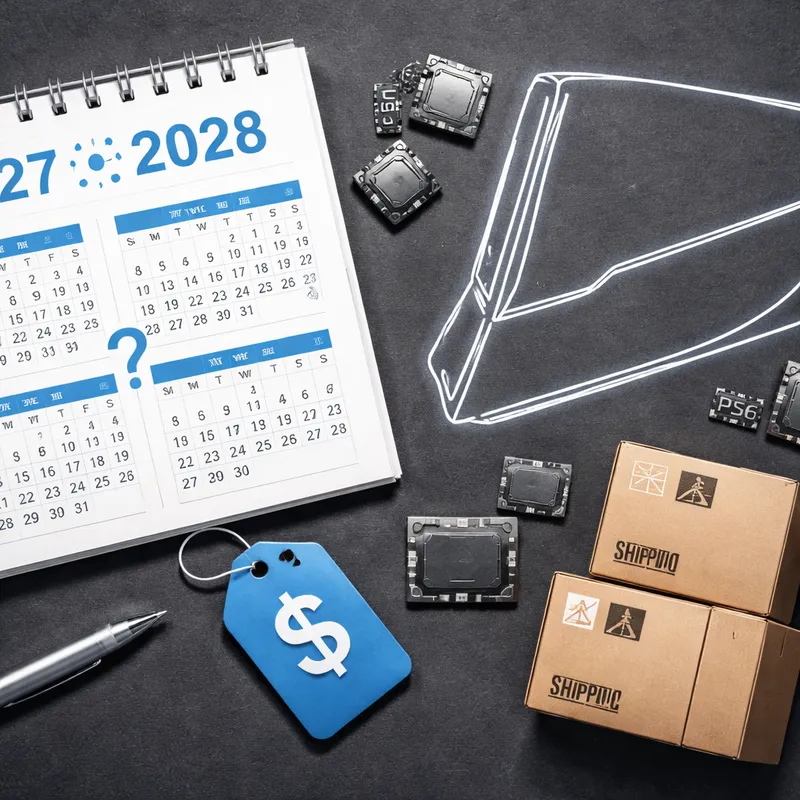
The current rumor window points to late 2027 or early 2028.
That lines up with the broader next-gen cycle and with claims that mass production could start in Q2 2027, assuming the roadmap does not change. It also fits the simple reality that Sony still has time to push the PS5 Pro and cross-gen releases before making a full jump.
So if you are searching for the PlayStation 6 release date, the best answer right now is:
- Not confirmed by Sony
- Most likely late 2027 to early 2028 based on leaks and industry chatter
Anything more precise than that is guesswork.
Will the PS6 be $600, $749, or even more?
Pricing may be the biggest wild card.
Reports mention supply pressure, memory costs, and a broader DRAM shortage. There are also rumors that console makers may accept higher launch prices than in past cycles. Some social posts go much further and claim potential pricing like:
- $499 to $649 for a rumored handheld model
- $749 for the main "Orion" console
- Up to $949 in tariff-heavy scenarios
Those numbers are not official, but they tell you what people are worried about. If Sony wants PS6 to offer near high-end PC-like RT features, the box probably will not be cheap.
My take: $600 sounds possible, but not guaranteed. If the final hardware stays ambitious, Sony may aim above that. If costs stay too high, specs could be adjusted before launch.
Backward compatibility and the upgrade question
One rumor that keeps showing up is backward compatibility with PS4 and PS5 games.
That would make a lot of sense. It lowers the barrier to upgrading and gives Sony a cleaner transition. If PS6 can run older games with steadier frame rates, better resolution, and maybe improved RT in patched titles, that alone could be a selling point.
This is also why the upgrade may feel more practical than flashy. You may notice the value in older favorites running better before you notice a huge visual leap in every brand-new game.
Is the next-gen upgrade real, then?
Yes and no.
Yes, in the sense that multiple reports point to the same broad idea: Sony is likely targeting a clear jump in GPU capability, stronger ray tracing, and smarter AI-assisted rendering.
No, in the sense that the most viral part of the story, the 12x faster ray tracing line, is easy to overread. It probably does not mean 12x FPS, 12x better graphics in every game, or guaranteed RTX 5090-class real-world performance in your living room.
The most realistic reading is this:
- PS6 could be about 3x stronger than PS5 in raster
- RT hardware could be much more capable, maybe 6x to 12x in RT-specific tasks
- AI and PSSR-like techniques may do a lot of the heavy lifting
- Real game gains may vary a lot by engine and workload
- Pricing and final specs can still change before launch
That still sounds like a meaningful generational move. It just does not mean every headline version of the rumor is true.
FAQ
Will PS6 have better ray tracing?
Yes, if the leaks are accurate, PS6 should have much better ray tracing than PS5. Several reports point to a 6x to 12x RT improvement, and some summaries call it over a 10-fold increase in ray tracing. That said, Sony has not confirmed this, and RT gains do not always equal the same jump in actual gameplay FPS.
Will PS6 be as powerful as a 4090?
Probably not in a full one-to-one PC sense, but it may approach RTX 4090 or even RTX 5090-like ray tracing performance in certain comparisons if the boldest leak interpretation is right. Raw raster performance is likely lower than those top-end PC cards. A more realistic expectation is that PS6 could land closer to an RTX 4080-class overall experience.
What GPU will PS6 be equivalent to?
The best current estimate for a PS6 GPU equivalent is somewhere between an RTX 4080-level overall class and, in more optimistic RT-only comparisons, RTX 4090 or RTX 5090-like ray tracing territory. Exact equivalency is hard because consoles rely on fixed hardware, custom optimization, and AI upscaling.
Will the PS6 be $600?
It could be, but no official price exists. Some rumors suggest a handheld could target $499 to $649, while the main PS6 console could reach $749 or even higher in certain tariff scenarios. So $600 is possible, but it may not be the ceiling.
Is PS6 really 12x faster than PS5?
Not overall. The leak is about ray tracing performance, not total console performance in every task. The broader claim is closer to 3x raster performance and 6x to 12x RT performance versus the base PS5.
Will PS6 support 4K 120 FPS in most games?
That is one of the more aggressive rumors. It may be possible in some titles, especially with PSSR, AI upscaling, and lower internal rendering resolutions, but you should not expect every big next-gen game to hit native 4K 120 FPS.
Is there a PS6 leaked design yet?
No credible final PS6 leaked design has been confirmed by Sony. Most current rumors focus on performance targets, launch timing, and architecture rather than a verified final console look.

