AMD Zen 7 leak: 15-25% IPC uplift and what AM5 users should watch
AMD Zen 7 AM5 talk is heating up after a new leak claimed Zen 7 should deliver a 15-25% IPC uplift over Zen 6. That is a big number, even by normal CPU-generation standards. The leak says AMD's Zen 7 processors will target AM5 on desktop, which would matter a lot if you already own an AM5 board and DDR5 memory. If this is real, you may not need a whole new platform to get a meaningful jump in average IPC, cache, and possibly core counts. Still, this is a leak, not a product page, and you should treat every spec here as unconfirmed.
The main claims come from leak reporting picked up by TweakTown and HotHardware, both citing Moore's Law Is Dead. The broad picture is easy to understand:
- Zen 7 is reportedly codenamed Prometheus
- AMD may build Zen 7 on TSMC A14
- Desktop Zen 7 could stay on AM5
- IPC could improve by 15% to 25% over unreleased Zen 6
- Standard cores may get 2MB L2 per core
- Desktop chiplets may gain much larger cache options, including V-Cache on some parts
If you are planning your next CPU upgrade, this leak matters less as a shopping guide for today and more as a map of where AMD could take AM5 next.
What the 25% IPC claim actually means
IPC means instructions per cycle. In plain English, it tells you how much work a core can do at the same clock speed. So if Zen 7 really lands near the high end of that 15% to 25% range, AMD would be improving core efficiency in a very meaningful way.
That does not mean your real-world apps will all be 25% faster. Actual gains depend on:
- Clock speeds n- Memory behavior
- Cache hit rates
- Power limits
- Your workload, like gaming, compiling, rendering, or AI tasks
The leak also says some of the gain may come from cache changes alone, with one report pointing to about 8% of the uplift coming from cache design improvements. Another claimed internal benchmark suggests 16% to 20% average per-core uplift in non-gaming desktop workloads versus Zen 6.
That sounds strong, but remember the comparison point is Zen 6, which is not yet released. So you are looking at a future-versus-future claim, not a measured retail comparison you can verify today.
Why AM5 compatibility is the biggest part of this story
For many readers, the real headline is not just IPC. It is the chance that Zen 7 processors will stay on AM5.
That matters because platform cost often hurts more than CPU cost. If AMD keeps Zen 7 on AM5, you could potentially upgrade your processor without replacing:
- Your motherboard
- Your DDR5 kit
- Your cooler, in many cases
- Your whole Windows install and platform setup
This is exactly why AM4 lasted so long in the minds of PC builders. A mature socket gives you options. By the time Zen 7 arrives, AM5 boards, BIOS support, and DDR5 pricing should be far more settled than they were at launch.
My honest take: if AMD really extends AM5 into the Zen 7 era, that could be as valuable as the IPC gain itself.
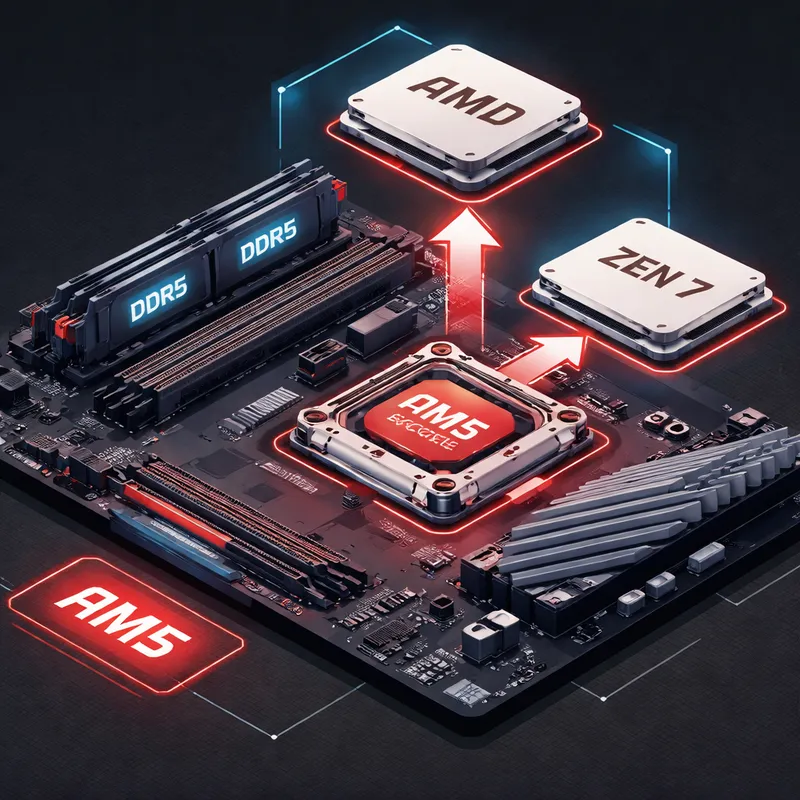
Leaked desktop details: Grimlock Ridge, Silverton, and Silverking
The desktop Zen 7 lineup is rumored to carry the Grimlock Ridge codename. The leak says it may remain compatible with the existing Zen 6-era I/O die strategy on AM5.
A few rumored desktop chiplet details stand out:
- Silverton chiplet: around 16 Zen 7 cores, optional V-Cache support
- Silverking chiplet: around 8 Zen 7 cores, reportedly no V-Cache support
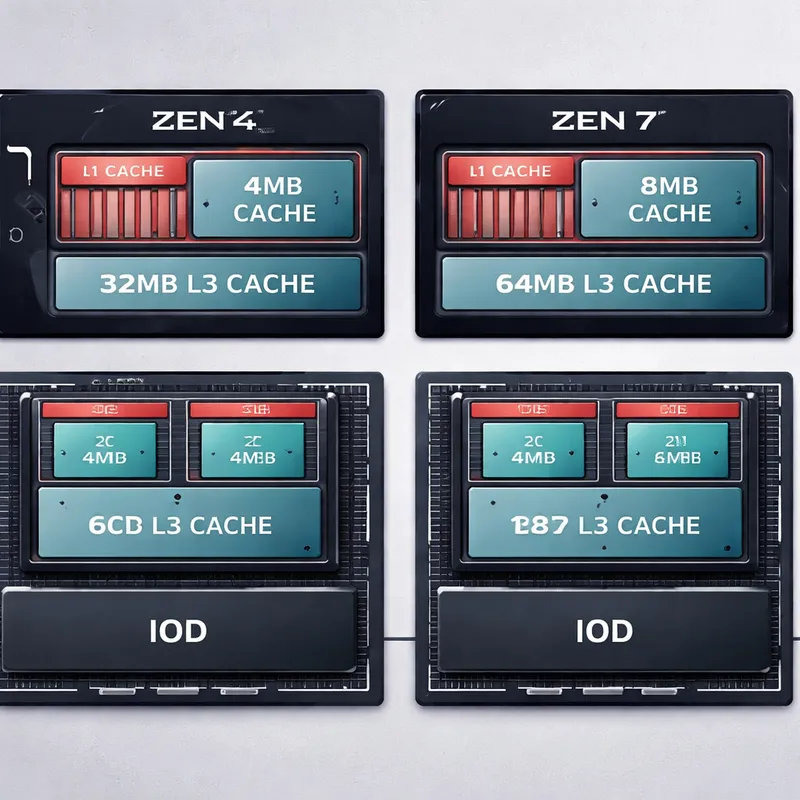
- 2MB L2 cache per core
- One report says 64MB on-die L3 per CCD on higher-end desktop parts
- A second-generation 3D V-Cache approach could push cache much higher on select chiplets
The jump to a 16-core CCD is important. Today, consumer chiplets have trained buyers to think in 8-core chunks. If AMD moves desktop chiplets to 16 cores, it changes how future Ryzen products could scale.
That does not mean you should expect wild 32-core or 72-core AM5 gaming CPUs on store shelves. One report mentions extreme theoretical layouts because the design is modular, but even that source says such products would be unlikely for normal consumers.
The more realistic takeaway is simpler: Zen 7 desktop chips could give you more cores per chiplet, more cache, and better per-core performance while still fitting the AM5 upgrade path.
Bigger cache could matter as much as IPC for gaming and mixed workloads
A lot of AMD's recent desktop success came from cache strategy, not just raw clocks. That is why the Zen 7 cache leak is a big deal.
The rumors point to:
- 2MB L2 per core as a new standard
- Larger L3 allocations per core
- Optional second-gen 3D V-Cache on some desktop chiplets
For gaming, large cache often helps keep more useful data closer to the CPU. That can reduce memory trips and improve frame times in the right games. For creators and power users, bigger cache can also help in compile jobs, simulation, data-heavy work, and some workstation tasks.
This does not guarantee every Zen 7 chip will beat every future Intel chip in every game. But if AMD combines a healthy IPC uplift with smarter cache, it gives AM5 upgrades a very strong angle.
AI acceleration and FP512 support: useful feature or headline bait?
The leak also says Zen 7 classic cores may include built-in AI acceleration and FP512 support, with claims of:
- 4x uplift in FP8
- 2x uplift in INT8 per cycle
These numbers sound dramatic, but you should be careful here. AI performance claims can be very specific to certain math types, kernels, and software paths. In the real world, the value depends on whether your apps actually use those instructions well.
If you mostly game and browse, this may not change much for you. If you run local AI tools, media workloads, or developer tasks that can use those paths, then Zen 7 could be more interesting than a normal CPU refresh.
In short, AI features are worth watching, but they are not the main reason most AM5 users would upgrade.
What this could mean for current AM5 owners
If you already own AM5, you can think about Zen 7 in three simple upgrade scenarios.
1. You are on Ryzen 7000 and want one last big AM5 upgrade
This is the sweet spot. If Zen 7 stays on AM5 and the leak is even partly accurate, you could skip several generations and make one bigger jump later. That would likely bring a much better value story than replacing board, RAM, and CPU together.
2. You are considering Zen 5 or Zen 6 and wondering whether to wait
This depends on timing. Zen 7 is not close. The leak points to mid-2028 production for EPYC Florence and a likely late-2028 launch window for server parts. Desktop timing is not fully confirmed, but it suggests Zen 7 is still years away.
So if your PC feels slow now, waiting for Zen 7 may be a mistake. Buy what solves your problem when you need it.
3. You care most about gaming and X3D-style chips
This is where Zen 7 becomes fun to think about. If AMD really brings larger cache and optional V-Cache support to 16-core desktop chiplets, future X3D-like parts could be very attractive for enthusiasts. We do not know a Zen 6 X3D release date from these leaks, and we definitely do not have a Zen 7 X3D schedule, but cache remains one of AMD's biggest weapons.
Zen 7 release date, Zen 6 timing, and why you should not plan too far ahead
Let's separate rumor from calendar reality.
AMD Zen 7 release date
There is no official AMD Zen 7 release date yet. The leak only suggests mid-2028 production for EPYC Florence and a likely late-2028 launch window. Desktop Zen 7 on AM5 would likely be around that broader period, but that is still speculation.
AMD Zen 6 release date
The leak compares Zen 7 against Zen 6, but Zen 6 is not released yet. The Google-style question "When can we expect Zen 6?" does not have a confirmed official date in the material provided here. Broader roadmap chatter points to AMD rolling out Zen 6-era products before Zen 7, with 2026 often discussed around EPYC Venice, but specific consumer timing still needs official confirmation.
Is AMD releasing a new CPU in 2026?
Yes, AMD is expected to introduce new CPU products in 2026, including Zen 6-based server parts like EPYC Venice, according to widely discussed roadmap expectations. That is separate from Zen 7, which appears much further out.
The practical lesson is simple: use leaks to understand direction, not to build a hard buying schedule.
How Zen 7 compares with the bigger roadmap: Zen 5, Zen 6, and even AMD Zen 8
People already search for terms like AMD Zen 5, AMD Zen 6 vs Intel Nova Lake, and even AMD Zen 8. That makes sense because buyers want to know whether to upgrade now or wait.
A reasonable way to think about it is this:
- Zen 5 is the near-term real-world baseline many buyers can actually evaluate
- Zen 6 should be the next official step before Zen 7
- Zen 7 looks like a larger architectural swing if these IPC and cache claims hold up
- AMD Zen 8 is too far away to matter for any practical upgrade decision today
If you are building in 2026 or 2027, Zen 5 and then Zen 6 are the real decision points. Zen 7 is more of a long-view reason to feel good about the AM5 platform staying useful.
The biggest reasons to be skeptical
I like exciting CPU leaks as much as anyone, but there are a few reasons to keep your feet on the ground.
- Zen 6 is unreleased, so the comparison baseline is not public yet.
- Leak numbers often describe best-case internal targets, not final retail averages.
- Cache and core layout details can change during development.
- Platform compatibility can shift if power, I/O, or packaging goals change.
- Desktop launch timing remains unclear even if server timing leaks are roughly right.
So yes, the Zen 7 AM5 story is exciting. No, you should not cancel a sensible upgrade today because of an unconfirmed 2028 rumor.

Should you wait for Zen 7 if you want an AM5 upgrade?
For most people, no.
If you already have AM5, the best move is usually to buy based on what is available when you need performance. The value of this leak is not that it tells you to wait. It tells you AM5 may still have a longer runway than some people expected.
That is good news for:
- Buyers choosing an AM5 motherboard today
- People investing in DDR5 now
- Users hoping for one more major CPU drop-in upgrade later
If the leak is even half right, Zen 7 could make AM5 feel like a smarter long-term platform purchase.
FAQ
Will Zen 7 be compatible with AM5?
Based on the leak, Zen 7 desktop CPUs are expected to support AM5. If that happens, it would help reduce upgrade costs because you could keep a mature AM5 motherboard and DDR5 memory instead of moving to a new platform. That said, AMD has not officially confirmed Zen 7 AM5 compatibility yet.
When can we expect Zen 6?
There is no official consumer release date confirmed here for Zen 6. The research material only makes clear that Zen 6 is still unreleased and that some roadmap discussion points to AMD launching Zen 6-era products before Zen 7. For now, the safe answer is: expect Zen 6 first, but wait for AMD's official launch details.
Will AMD leaked Zen 7 CPUs have more cores?
Possibly, yes. The leak suggests one major desktop change is a move to 16-core CCDs, which would be a step up from the 8-core consumer chiplet layout many buyers know today. That does not guarantee every Zen 7 CPU will have more total cores, but it strongly hints that AMD is exploring denser desktop chiplets.
Is AMD releasing a new CPU in 2026?
Yes. AMD is expected to release new CPU products in 2026, including Zen 6-based EPYC Venice server chips, according to roadmap expectations mentioned in search results. That is separate from Zen 7, which current leak reporting places much later.
Final take
The AMD Zen 7 leak is interesting because it combines three things AM5 users care about: a possible 15% to 25% IPC uplift, bigger cache, and rumored AM5 compatibility. Any one of those would be notable. Together, they suggest AMD may be trying to extend the value of AM5 while still pushing performance forward in a serious way.
But for now, keep the excitement in check. Zen 7 is still a rumor-heavy story, Zen 6 is not out yet, and real buying advice should come from real products. Still, if you wanted one reason to feel better about buying into AM5 today, this leak gives you one.

